Buy smeactor.eu ?
We are moving the project
smeactor.eu .
Are you interested in purchasing the domain
smeactor.eu ?
domain@kv-gmbh.de · 0541-91531010
Buy smeactor.eu ?
Which criterion is it, the root criterion or the quotient criterion?
It is the root criterion. This criterion states that if the limit of the absolute value of the terms of a series to the power of 1/n is less than 1, then the series converges. This criterion is used to test the convergence of series with non-negative terms. **
What are the Abel's convergence criterion and the Leibniz criterion?
Abel's convergence criterion states that if a series ∑an converges and the sequence {bn} is bounded and monotonically decreasing, then the series ∑anbn also converges. This criterion is useful for determining the convergence of a series when the terms can be factored into two separate sequences. The Leibniz criterion is a test for the convergence of alternating series. It states that if the terms of an alternating series satisfy the conditions of being monotonically decreasing and approaching zero, then the series converges. This criterion is particularly useful for determining the convergence of series with alternating signs. **


Similar search terms for Criterion
Top-Angebote
Products related to Criterion:
-
Sesderma Reti Age 5 Liposomal Serum Anti-Aging Innovation 30mLA facial serum for wrinkles and signs of ageing. Reduces wrinkles and fine lines. Hydrates and strengthens barrier. Restores youthful radiance. 5-Retinoid System: smooths wrinkles, accelerates renewal, and boosts collagen. Biomimetic Peptides: fill expression lines by stimulating collagen synthesis.41,69 £*Shipping: 5,34 £Secure redirect to the provider
-
HPE Installation & Startup Service - installation / configuration - for P/N 614167R-B21The Electronic HP Care Pack Services (e-Care Pack) capability allows you to order, receive, update, and activate a wide range of valuable HP Care Pack Services over the Internet. Administered through the HP Services Network (CSN), it is a fast and simple process that enables immediate registration and service activation. Choose HP Installation and Startup Service when you need to: have HP develop a custom configuration; cost-effectively obtain specialized expertise for a complex, one-time task;270,99 £*Shipping: 0,00 £Secure redirect to the provider
-
HARPERCOLLINS Creative Confidence by Tom & David Kelley – Unleashing Your Creative Potential & Innovation MindsetA powerful and inspiring book from the founders of IDEO, the award-winning design firm, on unleashing the creativity that lies within each and every one of us. Too often, companies and individuals assume that creativity and innovation are the domain of the ‘creative types’. But two of the foremost experts in innovation, design and creativity on the planet show us that each and every one of us is creative. In an entertaining and inspiring narrative that draws on countless stories from their work at IDEO, and with many of the world's top companies and design firms, David and Tom Kelley identify the principles and strategies that will allow us to tap into our creative potential in our work lives, and in our personal lives, allow us to think outside the box in terms of how we approach and solve problems. ‘Creative Confidence’ is a book that will help each of us be more productive and successful in our lives and in our careers.4,95 £*Shipping: 1,99 £Secure redirect to the provider




-
What is the difference between the quotient criterion and the difference criterion?
The quotient criterion and the difference criterion are both used to test for convergence or divergence of a series. The quotient criterion involves taking the limit of the ratio of consecutive terms in the series, and if the limit is less than 1, the series converges. The difference criterion involves taking the limit of the difference between consecutive terms in the series, and if the limit is 0, the series converges. In essence, the quotient criterion focuses on the ratio of consecutive terms, while the difference criterion focuses on the difference between consecutive terms. **
-
What is the exclusion criterion?
The exclusion criterion is a predefined set of conditions or characteristics that are used to determine which individuals or subjects should be excluded from a study or analysis. These criteria are established to ensure that the study results are not influenced by certain factors that could skew the findings or introduce bias. By applying exclusion criteria, researchers can maintain the integrity and validity of their study results. **
-
What is the sterilization criterion?
The sterilization criterion refers to the standard that must be met in order to ensure that a sterilization process has been successful in eliminating all forms of microbial life, including bacteria, viruses, and fungi. This criterion typically involves achieving a certain level of microbial reduction, often measured by a logarithmic reduction factor (e.g. a 6-log reduction for sterilization). Meeting the sterilization criterion is crucial in various industries such as healthcare, pharmaceuticals, and food processing to prevent the spread of infections and ensure product safety. **
-
What is the Leibniz criterion?
The Leibniz criterion is a test used to determine the convergence of an alternating series. It states that if the terms of an alternating series decrease in absolute value and approach zero, then the series converges. In other words, if the terms of the series eventually become smaller and smaller, the series will converge. This criterion is named after the German mathematician and philosopher Gottfried Wilhelm Leibniz. **

Is it a mistake to apply the majorant criterion here instead of the minorant criterion?
Yes, it would be a mistake to apply the majorant criterion instead of the minorant criterion in this case. The majorant criterion is used to show convergence, while the minorant criterion is used to show divergence. Since we are trying to show divergence in this case, the minorant criterion would be the appropriate choice. Using the majorant criterion would not provide the necessary information to prove divergence. **
What is the criterion of location?
The criterion of location refers to the factors that determine the ideal placement of a business, facility, or event. This criterion typically includes considerations such as proximity to target customers, accessibility, visibility, competition, and cost. By evaluating these factors, organizations can strategically select a location that maximizes their chances of success and meets the needs of their target audience. **
Top-Angebote
Products related to Criterion:
-
HPE Installation & Startup Service - installation / configurationThe Electronic HP Care Pack Services (e-Care Pack) capability allows you to order, receive, update, and activate a wide range of valuable HP Care Pack Services over the Internet. Administered through the HP Services Network (CSN), it is a fast and simple process that enables immediate registration and service activation. The installation and start-up service delivers expert support for this increasingly critical element of your eCommerce environment. This expert service quickly gets the storage2175,99 £*Shipping: 0,00 £Secure redirect to the provider
-
Sesderma Reti Age 5 Liposomal Serum Anti-Aging Innovation 30mLA facial serum for wrinkles and signs of ageing. Reduces wrinkles and fine lines. Hydrates and strengthens barrier. Restores youthful radiance. 5-Retinoid System: smooths wrinkles, accelerates renewal, and boosts collagen. Biomimetic Peptides: fill expression lines by stimulating collagen synthesis.41,69 £*Shipping: 5,34 £Secure redirect to the provider
-
Which criterion is it, the root criterion or the quotient criterion?
It is the root criterion. This criterion states that if the limit of the absolute value of the terms of a series to the power of 1/n is less than 1, then the series converges. This criterion is used to test the convergence of series with non-negative terms. **
-
What are the Abel's convergence criterion and the Leibniz criterion?
Abel's convergence criterion states that if a series ∑an converges and the sequence {bn} is bounded and monotonically decreasing, then the series ∑anbn also converges. This criterion is useful for determining the convergence of a series when the terms can be factored into two separate sequences. The Leibniz criterion is a test for the convergence of alternating series. It states that if the terms of an alternating series satisfy the conditions of being monotonically decreasing and approaching zero, then the series converges. This criterion is particularly useful for determining the convergence of series with alternating signs. **
-
What is the difference between the quotient criterion and the difference criterion?
The quotient criterion and the difference criterion are both used to test for convergence or divergence of a series. The quotient criterion involves taking the limit of the ratio of consecutive terms in the series, and if the limit is less than 1, the series converges. The difference criterion involves taking the limit of the difference between consecutive terms in the series, and if the limit is 0, the series converges. In essence, the quotient criterion focuses on the ratio of consecutive terms, while the difference criterion focuses on the difference between consecutive terms. **
-
What is the exclusion criterion?
The exclusion criterion is a predefined set of conditions or characteristics that are used to determine which individuals or subjects should be excluded from a study or analysis. These criteria are established to ensure that the study results are not influenced by certain factors that could skew the findings or introduce bias. By applying exclusion criteria, researchers can maintain the integrity and validity of their study results. **
Similar search terms for Criterion
-
HPE Installation & Startup Service - installation / configuration - for P/N 614167R-B21The Electronic HP Care Pack Services (e-Care Pack) capability allows you to order, receive, update, and activate a wide range of valuable HP Care Pack Services over the Internet. Administered through the HP Services Network (CSN), it is a fast and simple process that enables immediate registration and service activation. Choose HP Installation and Startup Service when you need to: have HP develop a custom configuration; cost-effectively obtain specialized expertise for a complex, one-time task;270,99 £*Shipping: 0,00 £Secure redirect to the provider
-
HARPERCOLLINS Creative Confidence by Tom & David Kelley – Unleashing Your Creative Potential & Innovation MindsetA powerful and inspiring book from the founders of IDEO, the award-winning design firm, on unleashing the creativity that lies within each and every one of us. Too often, companies and individuals assume that creativity and innovation are the domain of the ‘creative types’. But two of the foremost experts in innovation, design and creativity on the planet show us that each and every one of us is creative. In an entertaining and inspiring narrative that draws on countless stories from their work at IDEO, and with many of the world's top companies and design firms, David and Tom Kelley identify the principles and strategies that will allow us to tap into our creative potential in our work lives, and in our personal lives, allow us to think outside the box in terms of how we approach and solve problems. ‘Creative Confidence’ is a book that will help each of us be more productive and successful in our lives and in our careers.4,95 £*Shipping: 1,99 £Secure redirect to the provider
-
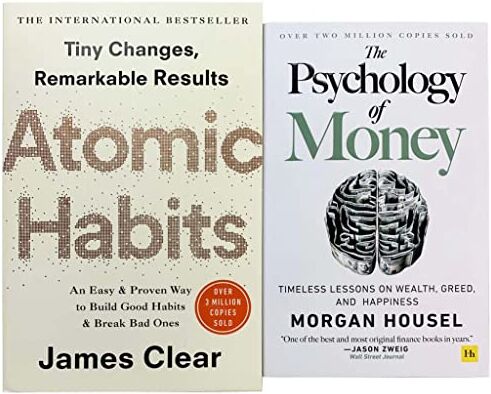
Random House Business/Harriman House ltd Atomic Habits & The Psychology of Money – 2 Books Collection Set Personal Growth, Wealth & Mindset BestsellersAtomic Habits People think that when you want to change your life, you need to think big. But world-renowned habits expert James Clear has discovered another way. He knows that real change comes from the compound effect of hundreds of small decisions: doing two push-ups a day, waking up five minutes early, or holding a single short phone call. He calls them atomic habits. In this ground-breaking book, Clears reveals exactly how these minuscule changes can grow into such life-altering outcomes. He uncovers a handful of simple life hacks (the forgotten art of Habit Stacking, the unexpected power of the Two Minute Rule, or the trick to entering the Goldilocks Zone), and delves into cutting-edge psychology and neuroscience to explain why they matter. Along the way, he tells inspiring stories of Olympic gold medalists, leading CEOs, and distinguished scientists who have used the science of tiny habits to stay productive, motivated, and happy. The Psychology of Money Doing well with money isn't necessarily about what you know. It's about how you behave. And behaviour is hard to teach, even to really smart people. Money investing, personal finance, and business decisions is typically taught as a math-based field, where data and formulas tell us exactly what to do. But in the real world people don't make financial decisions on a spreadsheet. They make them at the dinner table, or in a meeting room, where personal history, your own unique view of the world, ego, pride, marketing, and odd incentives are scrambled together. In The Psychology of Money, award-winning author Morgan Housel shares 19 short stories exploring the strange ways people think about money and teaches you how to make better sense of one of life's most important topics.15,99 £*Shipping: 2,99 £Secure redirect to the provider
-
What is the sterilization criterion?
The sterilization criterion refers to the standard that must be met in order to ensure that a sterilization process has been successful in eliminating all forms of microbial life, including bacteria, viruses, and fungi. This criterion typically involves achieving a certain level of microbial reduction, often measured by a logarithmic reduction factor (e.g. a 6-log reduction for sterilization). Meeting the sterilization criterion is crucial in various industries such as healthcare, pharmaceuticals, and food processing to prevent the spread of infections and ensure product safety. **
-
What is the Leibniz criterion?
The Leibniz criterion is a test used to determine the convergence of an alternating series. It states that if the terms of an alternating series decrease in absolute value and approach zero, then the series converges. In other words, if the terms of the series eventually become smaller and smaller, the series will converge. This criterion is named after the German mathematician and philosopher Gottfried Wilhelm Leibniz. **
-
Is it a mistake to apply the majorant criterion here instead of the minorant criterion?
Yes, it would be a mistake to apply the majorant criterion instead of the minorant criterion in this case. The majorant criterion is used to show convergence, while the minorant criterion is used to show divergence. Since we are trying to show divergence in this case, the minorant criterion would be the appropriate choice. Using the majorant criterion would not provide the necessary information to prove divergence. **
-
What is the criterion of location?
The criterion of location refers to the factors that determine the ideal placement of a business, facility, or event. This criterion typically includes considerations such as proximity to target customers, accessibility, visibility, competition, and cost. By evaluating these factors, organizations can strategically select a location that maximizes their chances of success and meets the needs of their target audience. **
* All prices are inclusive of VAT and, if applicable, plus shipping costs. The offer information is based on the details provided by the respective shop and is updated through automated processes. Real-time updates do not occur, so deviations can occur in individual cases. ** Note: Parts of this content were created by AI.