Buy smeactor.eu ?
We are moving the project
smeactor.eu .
Are you interested in purchasing the domain
smeactor.eu ?
domain@kv-gmbh.de · 0541-91531010
Buy smeactor.eu ?
What is proton donation and proton acceptance in chemistry?
Proton donation and proton acceptance are key concepts in acid-base chemistry. Proton donation refers to the transfer of a hydrogen ion (proton) from one substance to another. This typically occurs when an acid donates a proton to a base. Proton acceptance, on the other hand, involves the acceptance of a proton by a substance, often a base, leading to the formation of a new chemical species. These processes are fundamental to understanding the behavior of acids and bases in chemical reactions. **
What is meant by proton donors and proton acceptors?
Proton donors are substances that can donate a proton (H+) to another substance. This typically involves the release of a hydrogen ion. Proton acceptors, on the other hand, are substances that can accept a proton from another substance. This typically involves the uptake of a hydrogen ion. In the context of acid-base reactions, proton donors are acids, while proton acceptors are bases. **


Similar search terms for Proton
Top-Angebote
Products related to Proton:
-
Sesderma Reti Age 5 Liposomal Serum Anti-Aging Innovation 30mLA facial serum for wrinkles and signs of ageing. Reduces wrinkles and fine lines. Hydrates and strengthens barrier. Restores youthful radiance. 5-Retinoid System: smooths wrinkles, accelerates renewal, and boosts collagen. Biomimetic Peptides: fill expression lines by stimulating collagen synthesis.41,69 £*Shipping: 5,34 £Secure redirect to the provider
-
HPE Installation & Startup Service - installation / configuration - for P/N 614167R-B21The Electronic HP Care Pack Services (e-Care Pack) capability allows you to order, receive, update, and activate a wide range of valuable HP Care Pack Services over the Internet. Administered through the HP Services Network (CSN), it is a fast and simple process that enables immediate registration and service activation. Choose HP Installation and Startup Service when you need to: have HP develop a custom configuration; cost-effectively obtain specialized expertise for a complex, one-time task;270,99 £*Shipping: 0,00 £Secure redirect to the provider
-
HARPERCOLLINS Creative Confidence by Tom & David Kelley – Unleashing Your Creative Potential & Innovation MindsetA powerful and inspiring book from the founders of IDEO, the award-winning design firm, on unleashing the creativity that lies within each and every one of us. Too often, companies and individuals assume that creativity and innovation are the domain of the ‘creative types’. But two of the foremost experts in innovation, design and creativity on the planet show us that each and every one of us is creative. In an entertaining and inspiring narrative that draws on countless stories from their work at IDEO, and with many of the world's top companies and design firms, David and Tom Kelley identify the principles and strategies that will allow us to tap into our creative potential in our work lives, and in our personal lives, allow us to think outside the box in terms of how we approach and solve problems. ‘Creative Confidence’ is a book that will help each of us be more productive and successful in our lives and in our careers.4,95 £*Shipping: 1,99 £Secure redirect to the provider



-
What determines a proton donor and a proton acceptor?
A proton donor is a substance that can release a proton (H+) in a chemical reaction, while a proton acceptor is a substance that can accept a proton. This ability is determined by the presence of a hydrogen atom with a positive charge (H+) in the molecule. In general, substances with a lone pair of electrons, such as a hydroxide ion (OH-) or an amine group (NH2), can act as proton acceptors, while substances with a hydrogen atom bonded to an electronegative atom, such as a hydrochloric acid (HCl) or acetic acid (CH3COOH), can act as proton donors. **
-
Why are carboxylic acids proton donors and amines proton acceptors?
Carboxylic acids are proton donors because they contain a highly electronegative oxygen atom that can stabilize the resulting carboxylate anion by delocalizing the negative charge. Amines, on the other hand, are proton acceptors because they contain a lone pair of electrons on the nitrogen atom that can readily accept a proton to form a positively charged ammonium ion. This ability to donate or accept protons is due to the presence of functional groups in these molecules that can easily gain or lose a hydrogen ion in solution. **
-
Are there only proton-proton collisions in the particle accelerator?
No, there are not only proton-proton collisions in the particle accelerator. Particle accelerators can also collide protons with other particles such as electrons or heavy ions like lead or gold. These collisions are important for studying different aspects of particle physics and for exploring the fundamental forces and particles that make up the universe. By colliding different types of particles, scientists can gain a better understanding of the fundamental building blocks of matter and the forces that govern their interactions. **
-
How secure is Proton?
Proton is considered to be a highly secure email service. It offers end-to-end encryption for emails, meaning that only the sender and recipient can read the contents of the messages. Proton also uses strong encryption protocols to protect user data and has a strict privacy policy that ensures user information is not shared with third parties. Additionally, Proton is based in Switzerland, known for its strong privacy laws, adding an extra layer of security for users. **

What are proton currents?
Proton currents refer to the flow of protons, which are positively charged particles, through a medium. This flow of protons can occur in various contexts, such as in biological systems, in proton-conducting materials, or in the context of proton exchange membrane fuel cells. Proton currents are important in many physiological processes, such as the generation of energy in cells through the process of oxidative phosphorylation. In the context of proton-conducting materials and fuel cells, proton currents are important for the generation of electrical energy. **
What is proton decay?
Proton decay is a theoretical process in which a proton, one of the fundamental particles that make up an atom's nucleus, decays into lighter particles. This process is predicted by some grand unified theories (GUTs) that seek to unify the electromagnetic, weak, and strong nuclear forces. If proton decay were to occur, it would have profound implications for our understanding of the fundamental forces and particles in the universe. However, despite extensive experimental efforts, proton decay has not been observed, and its theoretical prediction remains unconfirmed. **
Top-Angebote
Products related to Proton:
-
HPE Installation & Startup Service - installation / configurationThe Electronic HP Care Pack Services (e-Care Pack) capability allows you to order, receive, update, and activate a wide range of valuable HP Care Pack Services over the Internet. Administered through the HP Services Network (CSN), it is a fast and simple process that enables immediate registration and service activation. The installation and start-up service delivers expert support for this increasingly critical element of your eCommerce environment. This expert service quickly gets the storage2175,99 £*Shipping: 0,00 £Secure redirect to the provider
-
Sesderma Reti Age 5 Liposomal Serum Anti-Aging Innovation 30mLA facial serum for wrinkles and signs of ageing. Reduces wrinkles and fine lines. Hydrates and strengthens barrier. Restores youthful radiance. 5-Retinoid System: smooths wrinkles, accelerates renewal, and boosts collagen. Biomimetic Peptides: fill expression lines by stimulating collagen synthesis.41,69 £*Shipping: 5,34 £Secure redirect to the provider
-
What is proton donation and proton acceptance in chemistry?
Proton donation and proton acceptance are key concepts in acid-base chemistry. Proton donation refers to the transfer of a hydrogen ion (proton) from one substance to another. This typically occurs when an acid donates a proton to a base. Proton acceptance, on the other hand, involves the acceptance of a proton by a substance, often a base, leading to the formation of a new chemical species. These processes are fundamental to understanding the behavior of acids and bases in chemical reactions. **
-
What is meant by proton donors and proton acceptors?
Proton donors are substances that can donate a proton (H+) to another substance. This typically involves the release of a hydrogen ion. Proton acceptors, on the other hand, are substances that can accept a proton from another substance. This typically involves the uptake of a hydrogen ion. In the context of acid-base reactions, proton donors are acids, while proton acceptors are bases. **
-
What determines a proton donor and a proton acceptor?
A proton donor is a substance that can release a proton (H+) in a chemical reaction, while a proton acceptor is a substance that can accept a proton. This ability is determined by the presence of a hydrogen atom with a positive charge (H+) in the molecule. In general, substances with a lone pair of electrons, such as a hydroxide ion (OH-) or an amine group (NH2), can act as proton acceptors, while substances with a hydrogen atom bonded to an electronegative atom, such as a hydrochloric acid (HCl) or acetic acid (CH3COOH), can act as proton donors. **
-
Why are carboxylic acids proton donors and amines proton acceptors?
Carboxylic acids are proton donors because they contain a highly electronegative oxygen atom that can stabilize the resulting carboxylate anion by delocalizing the negative charge. Amines, on the other hand, are proton acceptors because they contain a lone pair of electrons on the nitrogen atom that can readily accept a proton to form a positively charged ammonium ion. This ability to donate or accept protons is due to the presence of functional groups in these molecules that can easily gain or lose a hydrogen ion in solution. **
Similar search terms for Proton
-
HPE Installation & Startup Service - installation / configuration - for P/N 614167R-B21The Electronic HP Care Pack Services (e-Care Pack) capability allows you to order, receive, update, and activate a wide range of valuable HP Care Pack Services over the Internet. Administered through the HP Services Network (CSN), it is a fast and simple process that enables immediate registration and service activation. Choose HP Installation and Startup Service when you need to: have HP develop a custom configuration; cost-effectively obtain specialized expertise for a complex, one-time task;270,99 £*Shipping: 0,00 £Secure redirect to the provider
-
HARPERCOLLINS Creative Confidence by Tom & David Kelley – Unleashing Your Creative Potential & Innovation MindsetA powerful and inspiring book from the founders of IDEO, the award-winning design firm, on unleashing the creativity that lies within each and every one of us. Too often, companies and individuals assume that creativity and innovation are the domain of the ‘creative types’. But two of the foremost experts in innovation, design and creativity on the planet show us that each and every one of us is creative. In an entertaining and inspiring narrative that draws on countless stories from their work at IDEO, and with many of the world's top companies and design firms, David and Tom Kelley identify the principles and strategies that will allow us to tap into our creative potential in our work lives, and in our personal lives, allow us to think outside the box in terms of how we approach and solve problems. ‘Creative Confidence’ is a book that will help each of us be more productive and successful in our lives and in our careers.4,95 £*Shipping: 1,99 £Secure redirect to the provider
-
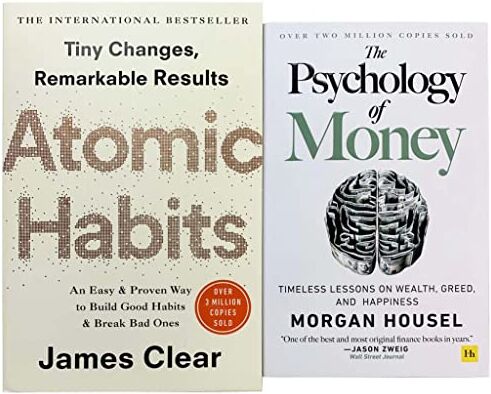
Random House Business/Harriman House ltd Atomic Habits & The Psychology of Money – 2 Books Collection Set Personal Growth, Wealth & Mindset BestsellersAtomic Habits People think that when you want to change your life, you need to think big. But world-renowned habits expert James Clear has discovered another way. He knows that real change comes from the compound effect of hundreds of small decisions: doing two push-ups a day, waking up five minutes early, or holding a single short phone call. He calls them atomic habits. In this ground-breaking book, Clears reveals exactly how these minuscule changes can grow into such life-altering outcomes. He uncovers a handful of simple life hacks (the forgotten art of Habit Stacking, the unexpected power of the Two Minute Rule, or the trick to entering the Goldilocks Zone), and delves into cutting-edge psychology and neuroscience to explain why they matter. Along the way, he tells inspiring stories of Olympic gold medalists, leading CEOs, and distinguished scientists who have used the science of tiny habits to stay productive, motivated, and happy. The Psychology of Money Doing well with money isn't necessarily about what you know. It's about how you behave. And behaviour is hard to teach, even to really smart people. Money investing, personal finance, and business decisions is typically taught as a math-based field, where data and formulas tell us exactly what to do. But in the real world people don't make financial decisions on a spreadsheet. They make them at the dinner table, or in a meeting room, where personal history, your own unique view of the world, ego, pride, marketing, and odd incentives are scrambled together. In The Psychology of Money, award-winning author Morgan Housel shares 19 short stories exploring the strange ways people think about money and teaches you how to make better sense of one of life's most important topics.15,99 £*Shipping: 2,99 £Secure redirect to the provider
-
Are there only proton-proton collisions in the particle accelerator?
No, there are not only proton-proton collisions in the particle accelerator. Particle accelerators can also collide protons with other particles such as electrons or heavy ions like lead or gold. These collisions are important for studying different aspects of particle physics and for exploring the fundamental forces and particles that make up the universe. By colliding different types of particles, scientists can gain a better understanding of the fundamental building blocks of matter and the forces that govern their interactions. **
-
How secure is Proton?
Proton is considered to be a highly secure email service. It offers end-to-end encryption for emails, meaning that only the sender and recipient can read the contents of the messages. Proton also uses strong encryption protocols to protect user data and has a strict privacy policy that ensures user information is not shared with third parties. Additionally, Proton is based in Switzerland, known for its strong privacy laws, adding an extra layer of security for users. **
-
What are proton currents?
Proton currents refer to the flow of protons, which are positively charged particles, through a medium. This flow of protons can occur in various contexts, such as in biological systems, in proton-conducting materials, or in the context of proton exchange membrane fuel cells. Proton currents are important in many physiological processes, such as the generation of energy in cells through the process of oxidative phosphorylation. In the context of proton-conducting materials and fuel cells, proton currents are important for the generation of electrical energy. **
-
What is proton decay?
Proton decay is a theoretical process in which a proton, one of the fundamental particles that make up an atom's nucleus, decays into lighter particles. This process is predicted by some grand unified theories (GUTs) that seek to unify the electromagnetic, weak, and strong nuclear forces. If proton decay were to occur, it would have profound implications for our understanding of the fundamental forces and particles in the universe. However, despite extensive experimental efforts, proton decay has not been observed, and its theoretical prediction remains unconfirmed. **
* All prices are inclusive of VAT and, if applicable, plus shipping costs. The offer information is based on the details provided by the respective shop and is updated through automated processes. Real-time updates do not occur, so deviations can occur in individual cases. ** Note: Parts of this content were created by AI.